

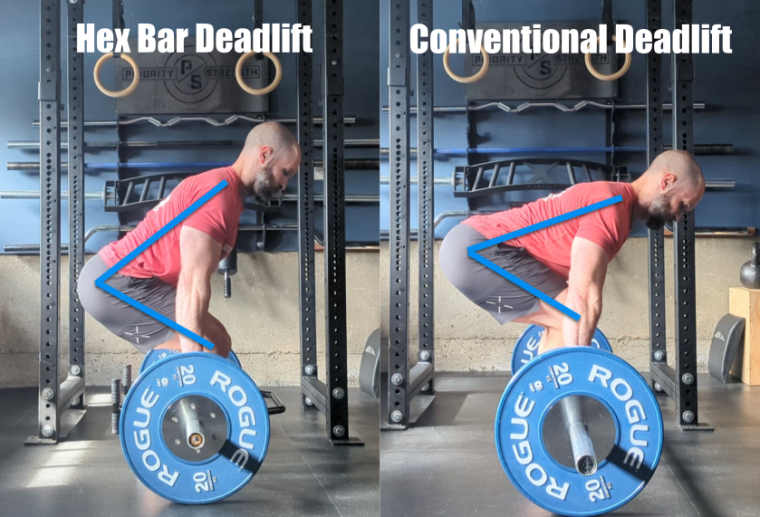
The hex bar deadlift (or trap bar, if you prefer) differs from a conventional deadlift in two meaningful ways. The first is that the shape of the bar allows for a more natural posture than with a standard deadlift. When using a standard barbell, your shins need to be pressed back toward vertical for the bar to stay in line with your center of gravity. Pressing your shins back results in a higher hip position and a very posterior chain, back-focused exercise.
With the hex bar deadlift, your legs don’t need to work around the barbell, so your shins can shift forward and your hips can sink comparatively lower than with a standard deadlift. This makes for a more even balance between your anterior (quads) and posterior (back and hammies) sides, so you can think of the hex bar deadlift as occupying the middle ground between a deadlift and a squat.
The second difference with the hex bar is that it usually allows for two different hand positions. The “high” set of handles protrudes upward, effectively reducing the range of motion by three or four inches. But by flipping the bar over, your hands align with the center of the plates just as they are with a standard barbell. It’s pretty common to be surprised at how much easier a hex bar deadlift is than a conventional deadlift, which is often thanks to the shorter range of motion when using the high handles.
As is always the case when comparing one exercise to another, neither is inherently better or worse. They’re just different, and we’ll employ these subtle differences to accomplish different training goals throughout your program.