

Pullup Progression
PART 2
·Next step for pullups: negatives
·Set up your station so you can begin with your chin over the bar without jumping
·Go easy at first, because they can make you quite sore
·If bodyweight negatives are still out of reach, combine negatives with the assisted pullup machine
·Use the “Pullup Negatives” progression listed in this resource collection
Now that you’ve used the assisted pullup machine or lat pulldown for a few weeks, it may be time to move on to a far more potent method for building your pullup capacity: negatives. A negative is a resistance training method where you effectively skip an exercise’s ‘lift’ component and focus exclusively on the way down. For a pullup negative, this means using a box, j-cup, or something else you can climb on so you begin with your chin over the bar, then slowly lower yourself downward until your arms extend. Negatives work so well here because your eccentric capacity is always greater than your concentric capacity. In other words, you can always lower more weight than you can lift. So, even if you can’t do a pullup, you may be strong enough for the lowering phase.
When using negatives, disregard the rep count and tempo listed for your A2 exercise. You can keep the same number of sets, but the number of repetitions and tempo will depend entirely on where you are in the progression.
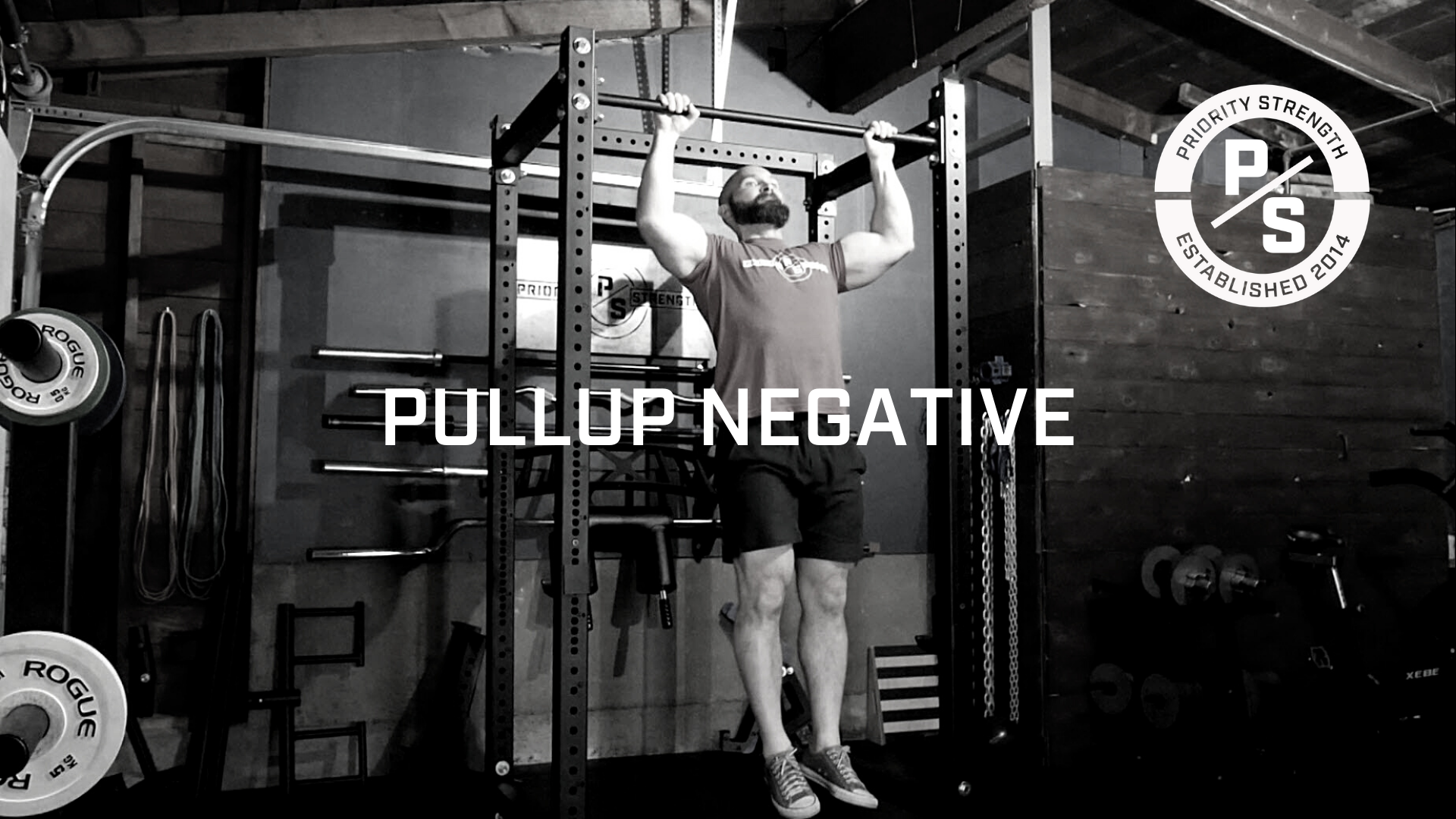
To begin, aim for 2-4 repetitions each set and take four seconds on the way down with each repetition. We would write that tempo as [41A1] – four seconds on the way down, one second at both the top and bottom to get your bearings and establish control, and ‘A’ for ‘assisted’, meaning you perform zero actual pulling on the way up. As you improve, you’ll add more repetitions and take longer with each descent. You’ll find a step-by-step “pullup negatives” in the resource collection, as well as at the bottom of this page. Swap in the appropriate stage of the progression in place of your A2 exercise while keeping the listed hand position and number of sets.
One crucial element of a successful negative is to start the repetition with your chin comfortably over the bar. This means you should set up your station so you do not need to jump to get your chin high enough. Jumping to the top of each rep makes it impossible to control the top pause, which will invariably cause you to swing around. Another excellent method is to perform negatives in a rack and use a set of j-cups (the adjustable hooks that hold each end of the barbell in the rack) as a sort of step ladder to get your chin high enough (see the “Pullup Negative” video demo in the guides section for a visual on using the j-cups).
Negatives are far and away the most powerful tool in the toolkit for building your pullup capacity. So why don’t we start with them? Well, in some sense, they’re too powerful. Negatives can make you very sore if you’re not careful, especially if you haven’t spent time developing some concentric (the way up) strength. A lot of the soreness you feel after a workout results from the work performed during the eccentric phase of an exercise (which is one reason why PS workouts lean into eccentric control so much). So be careful with these as you begin, and don’t push too hard in your first couple of sessions. If you wake up with only moderate soreness, you can test your limits more with each workout.
Last thing: it may very well be that this isn’t the right time for you to start thinking about negatives. They’re tough, and plenty of trainees will benefit from much more time using the assisted pullup machine. In fact, you can use the assisted pullup machine to get started with your negatives. If you usually use 8 plates for assisted pullups, try using 3 or 4 plates of assistance to help with your negatives. Everybody starts from a different place and moves along the progression curve at a different rate, so I can’t know where any individual trainee is. We’ll introduce the final stage of the pullup progression in the coming weeks, but do feel free to move through each step at your own pace. These notes will always be available to you in the ‘guides’ tab of the PS app for you to access when the time is right.